
Insights

Kramer for The Des Moines Register: Americans want a government that delivers for them | Opinion
Published on November 1, 2026
By Cori Kramer, CEO, Center Forward | Featured in The Des Moines Register
With the midterm elections just weeks away, political strategists are already preparing their explanations for what the results will mean. Depending on who wins, we’ll hear that voters have embraced one party’s agenda, rejected the other’s ideology, or delivered a mandate for a new direction.
But what if voters are trying to tell us something simpler?
They’re tired of a government that doesn’t seem to work for them.
For the past two years, Center Forward has followed a group of American voters through a series of research journals, asking about their concerns, expectations of government, and the country’s direction. Our sixth round, conducted in September, offers a revealing look at the frustration building across the political spectrum.
This isn’t a traditional national poll. It’s drawn from in-depth conversations with 35 voters who participated in the 2024 general election but not the primaries, and who have shared their views with us repeatedly since then. That continuity helps us understand how their attitudes have changed.
Not a single participant said they felt happy or proud about the country’s direction. Frustration remains the dominant emotion, and disappointment is growing. Republicans, Democrats, and Independents disagree about plenty, including who deserves the blame. But they share a sense that Washington is failing to address the issues that matter most in their everyday lives.
Perhaps the most revealing finding is the disconnect between what voters want Congress to do and what they believe it will accomplish.
Affordability was the most frequently mentioned priority for the next Congress, followed by concerns about health care costs and access. Yet when asked what they realistically expected Congress to spend its time on, voters pointed to partisan fighting, investigations, and political retaliation.
These voters can clearly identify the problems they want their elected officials to address. They simply don’t believe those officials will prioritize solving them.
That gap between expectations and reality may be one of the greatest challenges facing our political system.
It also helps explain another finding: candidates moving away from the political center.
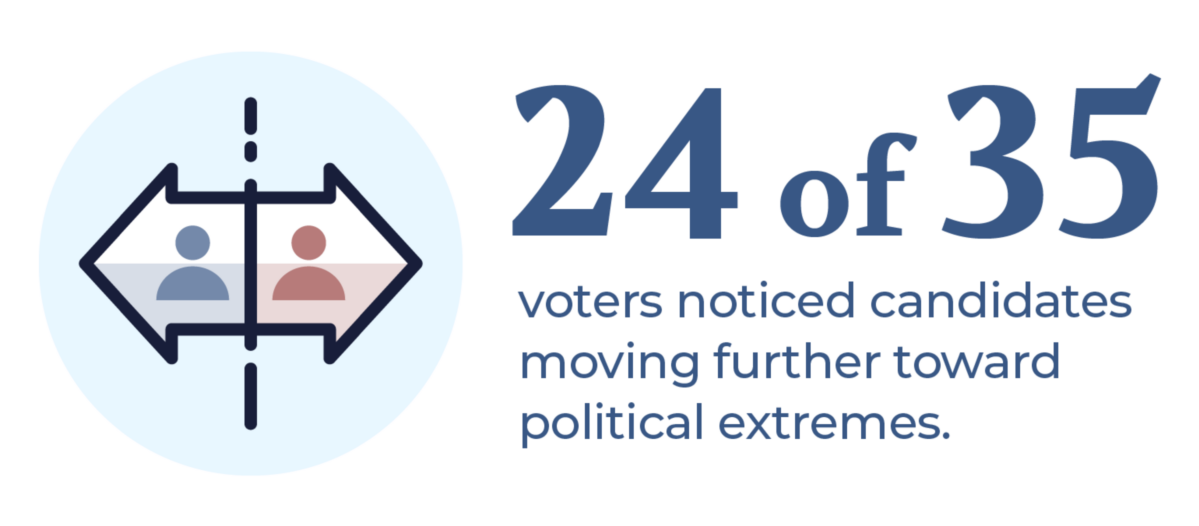
Twenty-four of the 35 participants said they had noticed candidates moving further toward the political extremes.
We often talk about polarization as though Americans are demanding increasingly extreme policies. Certainly, some are. But our research suggests another dynamic: frustration with the status quo is pushing people toward candidates who promise to disrupt it.
In other words, the political center has a performance problem.
For those of us who believe in bipartisan cooperation, that should prompt some serious reflection.
It’s not enough to argue that compromise is a virtue or that politicians should be more civil. Those things matter, but Americans aren’t looking for bipartisanship for its own sake.
They want results.
They want elected officials who can work across party lines to address the cost of living, improve access to affordable health care, and tackle challenges neither party can solve alone.
They also want Congress to exercise its constitutional responsibilities without turning every disagreement into another partisan spectacle.
That doesn’t mean voters oppose accountability, but they do believe governing cannot become an endless cycle of investigating political opponents while the country’s problems go unresolved. Congress can provide meaningful oversight and still legislate. A functioning Congress should be expected to do both.
The challenge is that too many Americans no longer believe it will.
That skepticism extends to their own participation in democracy.
Most participants were confident their votes would be counted accurately, so the concern isn’t simply whether elections are run fairly; it’s whether elected officials will listen once the votes are counted.
Amid this distrust, leaders in both parties have an opportunity to look beyond slogans about unity and deliver results voters can see and feel in their own lives.
That means identifying issues where bipartisan agreement is possible, prioritizing them, and accepting progress even when neither side gets everything it wants.
It also means recognizing that compromise isn’t the absence of conviction. Governing a divided country requires building support beyond your own political coalition.
As we approach November, both parties should resist interpreting every electoral victory as an endorsement of their most ideological positions. A vote against the status quo isn’t necessarily a vote for the opposite extreme.
Sometimes it’s simply a demand for something better.
If the political center wants to regain Americans’ confidence, it needs to prove it can deliver. And if Washington wants to restore public trust, it needs to spend less time arguing about which party is winning and more time showing Americans their government can still work.
That’s the mandate to which our leaders should be listening.